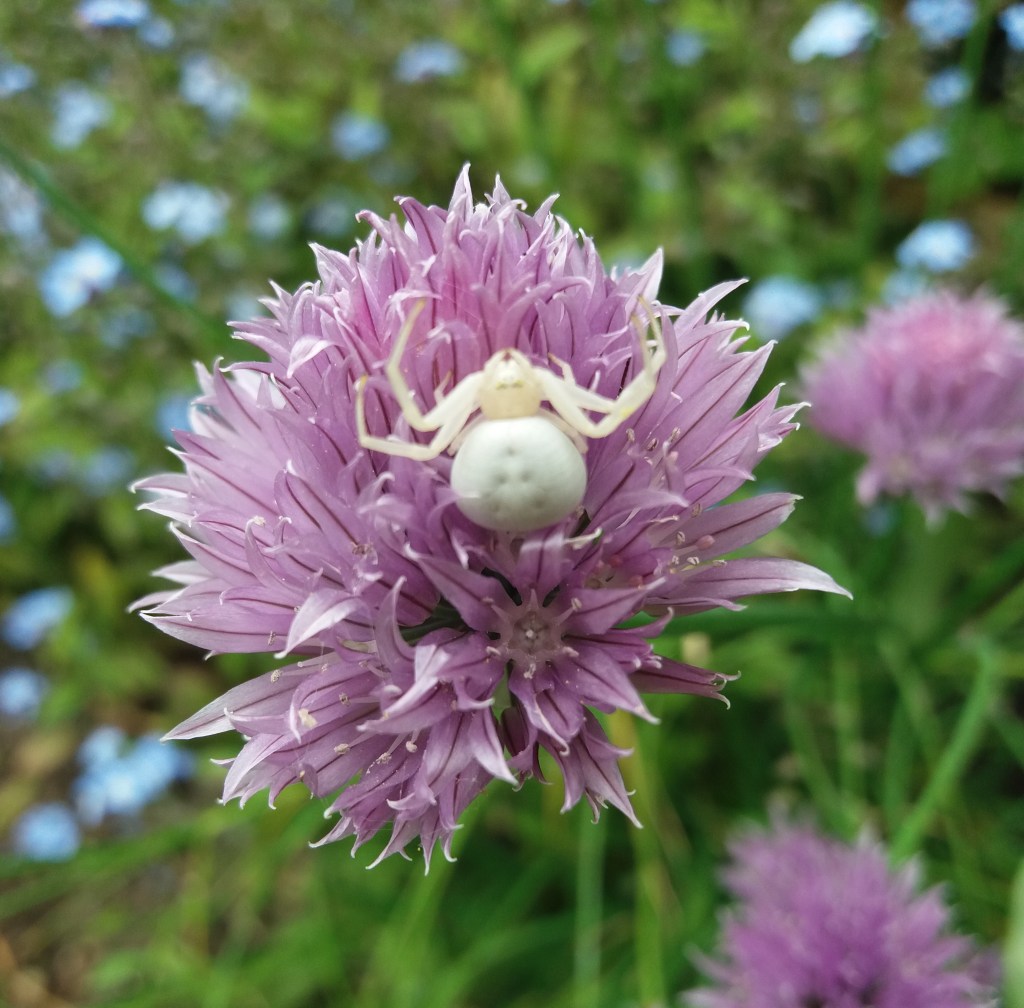
Many of the first flowers to emerge in spring in my garden here in Southern England are those of chives. Insects, especially bees, love them, as do I for their tasty leaves. I let them self seed and they grow in profusion.
In May last year (2023) they were flowering everywhere. I was on my usual morning prowl around with my camera when I spotted a bright white blob on one of the chive flowers. It was so startlingly obvious against the purple flower that at first I thought it was a bird dropping. On closer inspection, I was delighted to discover it to be a flower crab spider (Misumena vatia). She was poised in typical fashion with her first two pairs of legs (much longer than the other two pairs) outstretched in her crab-like pose, waiting to ambush visiting insects. I looked on the ground below the plant and, sure enough, there was the dry discarded husk of an unfortunate bumblebee. It was a large specimen. These spiders are able to tackle prey much larger than themselves. They do not use silk to catch and subdue their prey. They are ambush predators and rely on their speed to capture the insect, and then to hold on while their venomous bite paralyses it. This must have been quite some feat of strength when it came to the bumblebee.
The spider’s likeness to a crab doesn’t stop at her appearance. She can also run sideways in the manner of a crab, as well as backwards. However, her real and most surprising party trick is that she is able to change colour to match the flower she is sitting on, one of only a few species of spider able to do so. If placed on a yellow flower a white spider will gradually change to yellow over a period of a few days. They can also turn pink or pale green (for different reasons – see below), but white or yellow are the most commonly occurring colours. But the spider I had found shone like a beacon against the blue/purple of the chive flower, and very obvious even at a distance. I could even spot her from my kitchen window some 5 metres away. Surely a passing insect would notice her and avoid the flower, or at least see her movement when she pounced. Being small she is also preyed upon by birds and insect predators such as wasps. The answer lies in the vision of potential prey and predators. Both birds and insects can see in the ultraviolet part of the spectrum, and many of the insects do not have photoreceptors for the red/yellow parts of the spectrum. Anything that is white actually reflects all colours of the spectrum, so the white spider may just appear blue or as a darkish blob against a blue or purple flower because those are the only colours the insect will be able to see. Although birds can see the red/yellow parts of the spectrum it is likely that the blue would dominate, and provided the spider remains still it would not be obvious.

The way she changes colour is quite curious. Unlike cuttlefish and chameleons she does not possess chromatophores or melanophores (pigment containing cells), which those animals expand or contract to produce the rapid colour changes. Instead she has a translucent cuticle (outer skin layer). Her base colour is white due to a layer of crystals of guanine, which shows through the cuticle. The yellow colour is produced when the spider synthesises the yellow pigment between the guanine layer and the cuticle. It takes time to make the yellow pigment (around ten to twenty-five days), but less time to re-absorb it when she returns to white. This almost transparent cuticle means that she can also pick up colours from the prey she eats, which may be visible through the cuticle while she digests it.
It is only the female that can change colour like this. The male of the species is quite different and much smaller (only a third to half the size of the female) and darker. He does not have the same sedentary lifestyle as the female, and spends life wandering the vegetation in search of mature females to mate with. Sometimes if he comes across a female who is not quite ready he will stay with her and guard her from other males until the time comes to mate. This is risky as females are territorial and will not usually tolerate males until they are mature enough to mate. The males find the females by following the ‘draglines’ of silk that the female lays down when moving from flower to flower.
‘My’ spider stayed on her chive flower for many days before she disappeared. She was the first thing I looked for when I did my rounds of the garden each morning. I searched around on the nearby chives and found her a few inches away. The flower she had been sitting on was probably not attracting so many insects, as pollination was probably complete, or nearly so, and the flower would have stopped producing nectar for the pollinators. So she had moved on to pastures new. Of course, it may not have been her, but I like to think it was.
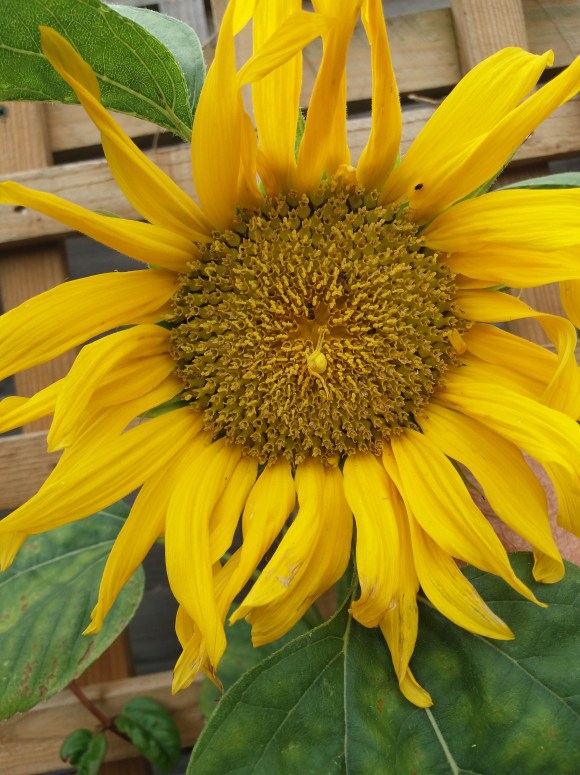
Later on in the summer I found a yellow spider on a sunflower, and this one was indeed well camouflaged and was very difficult to spot on the petals. I finally noticed it on the central inflorescence.
Sadly these spiders do not survive two winters. ‘My’ spider matured over her first year and overwintered as a spiderling, maturing in this her second year during which she mated. The male she mated with died very soon afterwards. She lived a few weeks longer while she made a nest for her eggs by bending and gluing leaves together, and then guarded this nest until her spiderlings hatched, after which she died.
So eventually I had to say goodbye to my pretty little spider as winter approached. I’ll look for her babies this year, with the hope that a few of them stay. They are quite welcome.
2024
 Nature Matters